
About Bhutan
Geography
Bhutan remained isolated and unknown to the outer world for many centuries, it came to be known to the outer world only a few decades ago and it is known as the Last Shangri-La. Bhutan is located in the eastern Himalayas, bordered by China in the north and India to the east, west and south. It can be divided into three zones geographically, including the southern foothills, central belt and northern highlands. For the time difference, Hong Kong is two hours ahead of Bhutan.
Climate
Southern Bhutan has a hot, humid sub-tropical climate that is fairly unchanging throughout the year. Temperatures can vary between 15-30 degrees Celsius. In the Central parts of the country the climate cools a bit, changing to temperate and deciduous forests with warm summers and cool, dry winters.
Gross National Happiness
The fourth King of Bhutan, Jigme Singye Wangchuck, coined the phrase Gross National Happiness when he emphasized that progress should not only bring about material development but also social well-being and happiness. Today, Gross National Happiness is the yardstick for measuring development in the country.
Discover
Punakha
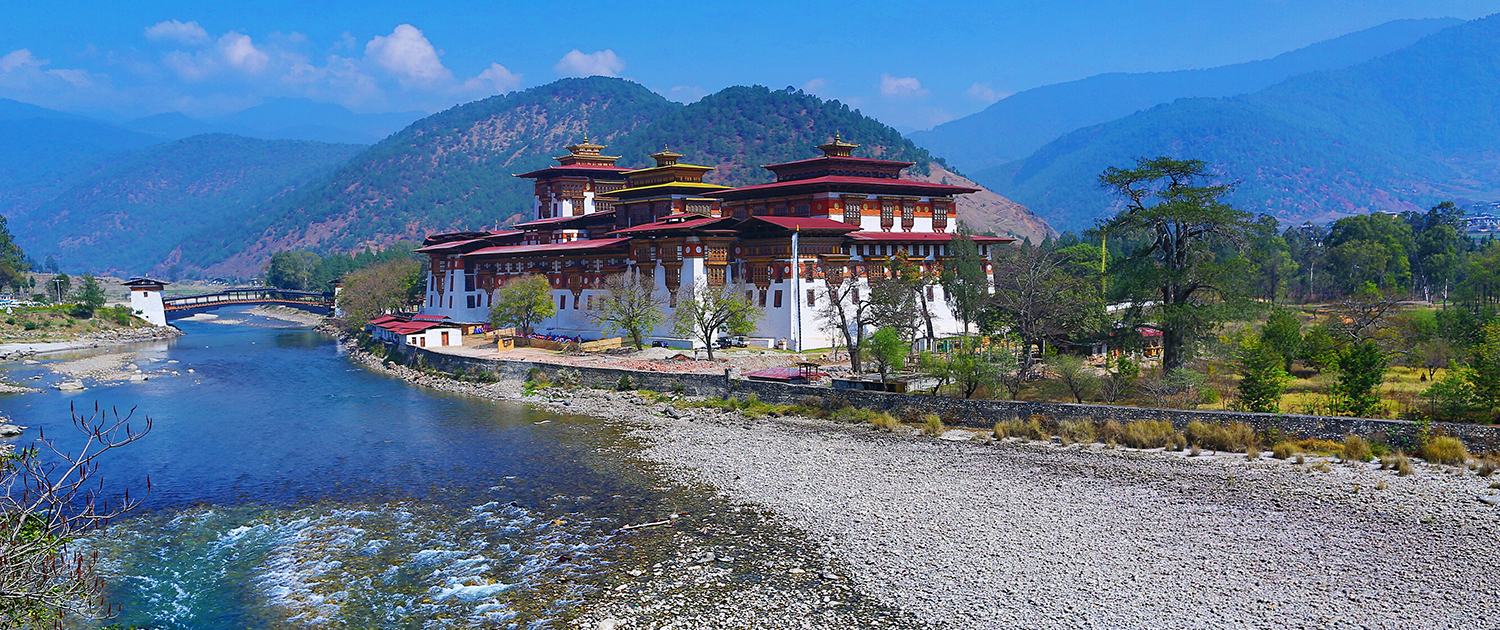
Punakha Dzong is the second oldest and second largest dzong in Bhutan and one of the most majestic structures in the country. Two major rivers in Bhutan the Pho Chhu and Mo Chhu converge in this valley. Punakha Dzong is built at the confluence of these two rivers and is an especially beautiful sight on sunny days with sunlight reflecting off the water onto its white-washed walls. At 2011, the wedding of the King of Bhutan and his fiancé was held at the Punakha
Taktsang Lhakhang
Taktsang Lhakhang is Bhutan’s most iconic landmark and religious site. The name Taktsang translates to “The Tiger’s Nest”. This temple is one of the most holy sites in the kingdom and clings impossibly to a sheer cliff face 900 hundred meters above the Paro Valley. In order to arrive at the temple visitors must trek for around 2-3 hours through beautiful, shady pine forests. No trip to Bhutan would be complete without a visit to this remarkable heritage site.
Thimphu
Thimphu is the most modern city in Bhutan with an abundance of restaurants, internet cafes, nightclubs and shopping centers, however it still retains its’ cultural identity and values amidst the signs of modernization. Thimphu is one of the few towns in Bhutan that have been equipped with ATM banking facilities and is a good place to stock up on some currency.
Activities
Bird Watching
Bhutan is a paradise for bird lovers and ornithologists. Over 670 species of birds have been recorded and many more are yet to be discovered. Around 50 species of the known birds are winter migrants. These include ducks, waders, birds of prey, thrushes, finches and buntings.
Kayaking and Rafting
The crystal clear rivers of Bhutan are one of the kingdom’s best kept open secrets. Fed by the glacial-melt of the Eastern Himalayas, six major rivers have been scouted for kayaking and rafting. The pristine natural setting and the sheer variety of the rivers’ courses provides a unique opportunity to explore Bhutan’s beautiful wilderness. Adventurous travelers will not be disappointed by the rugged, untamed waterways of Bhutan.
Flora and Fauna
Nestled deep within the Himalayas, Bhutan is a treasure trove of biological diversity with an unparalleled richness of flora and fauna due to the varied altitudinal and climatic conditions present in the country. This fragile ecosystem has remained unspoiled due to the conservation efforts of the Bhutanese people and government. Today 60% of the kingdom’s total area has been designated as protected nature preserves. Visitors can experience the magnificent flora and fauna of Bhutan through sightseeing tours or by embarking on treks and hikes.
Travel Tips
Tourist Visa
Bhutan tourist visa is required for citizens of Hong Kong.
Electricity
In Bhutan, electricity runs 220 / 240 volts. If you do bring electrical appliances, take along an international converter kit complete with a set of adapter plugs.
Language
There are two main languages in Bhutan. Dzongkha is the national language of Bhutan spoken in most parts of Bhutan and Nepali is spoken by the people of southern Bhutan who are of Nepalese origin.